This post contains affiliate links. If you click and make a purchase, we may earn a small commission at no extra cost to you.
Most of us are not lacking in mindfulness intentions. We have the intentions. We have the app we downloaded and opened twice. We have the journal we bought because the cover was beautiful and the pages are still mostly empty. We have, in the abstract, a genuine desire to be more present in our lives.
What we often don’t have is any idea what to do next Tuesday at 7pm when we have twenty minutes and the vague sense that we should probably use them for something other than scrolling.
This is exactly what printable mindfulness activities are designed to solve.
The blank page problem is underrated. Everyone talks about consistency and habit-stacking and finding your why, and almost nobody talks about the specific friction of sitting down to do something intentional and then immediately having to decide what that thing even is. Do I meditate? Journal? Breathe? Reflect on something? On what? For how long? Am I doing this right?
By the time you’ve answered those questions, your twenty minutes are twelve, and whatever quiet you were hoping to find has been replaced by the irritation of someone who just spent eight minutes failing to begin.
Structure solves this. Not in a rigid, follow-the-protocol way — in the way that a prompt gets you writing before you’ve talked yourself out of it. In the way that a specific exercise gives your mind something to actually do instead of spin. If you’ve ever tried one-minute mindfulness exercises and found them easier to start than an open-ended sit, you already know exactly what this means.
Table of Contents
What Are Printable Mindfulness Activities?
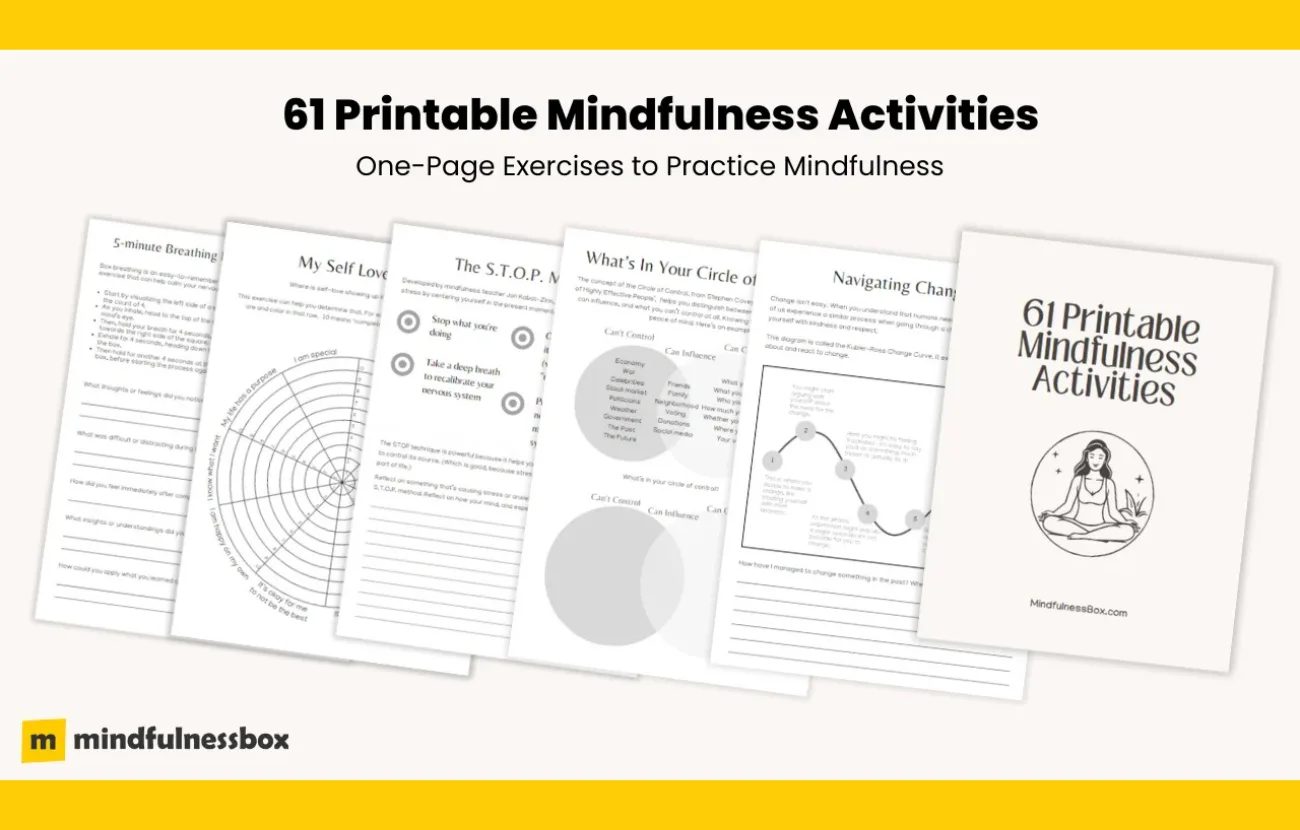
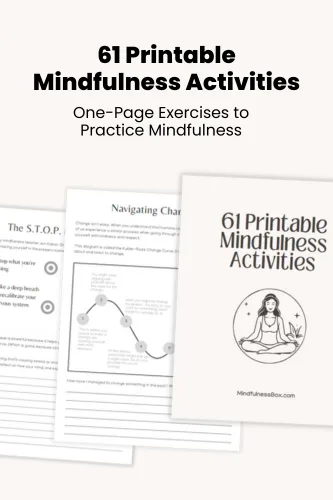
Printable mindfulness activities are one-page exercises that give you a clear, contained thing to do. They’re structured prompts — for journaling, reflecting, breathing, meditating, or working through an emotion — that are ready to use the moment you open them. No planning required. No deciding. You pick one, you do it, you’re done.
They work for exactly the same reason that a recipe works better than “cook something healthy.” The constraint isn’t limiting — it’s freeing. When the structure is already there, the only thing left is to show up.
What’s Inside: The 61 Printable Mindfulness Activities
This collection of 61 one-page exercises is organized across six areas. Here’s what each section covers.
Mindfulness
The largest section, and the most varied. Exercises here include a S.T.O.P. method worksheet, a mindfulness self-assessment, mindful reframing prompts, and a look at the 9 attitudes of mindfulness. There are also several five-minute exercises — box breathing, mindful walking, mindful listening, mindful music — for days when you want something short and grounded.
A few of the prompts go deeper: “What Makes a Good Life?”, “What’s In Your Circle of Control?”, and “How to Turn a Bad Day Around” are the kind of questions that seem simple until you actually sit with them.
Meditation
Six exercises covering the core meditation formats most people find useful. There’s a beginner’s guide (“How to Meditate: A Simple Guide”) for anyone still figuring out the basics, plus a daily meditation planner for building consistency. The guided formats — mountain meditation, loving-kindness meditation, concentration meditation, and mantra meditation — give you a specific practice to follow rather than an empty timer.
If you’re not sure which style fits you, the types of meditation practices post is a good companion read before working through this section.
Skip hours of prep time with 61 ready-to-use mindfulness exercises trusted by 600+ teachers, counselors, and facilitators. Build calm, focus, and emotional awareness in your classroom or group. Instant PDF download!
61 Printable Mindfulness Activities includes dozens of one-page exercises to help practice mindfulness, meditation, gratitude, and self love. Just $0.31 per activity! The activities are broken up into six sections: ✔ Mindfulness ✔ Meditation ✔ Gratitude ✔ Self Love ✔ Emotions ✔ Intention
Gratitude
Ten exercises, including two gratitude journal formats, a gratitude timeline that spans your whole life (not just today), and a “Gratitude for Life Milestones” prompt that tends to surface things you’ve stopped noticing. There’s also a negative visualization technique — borrowed from Stoic practice — which approaches gratitude from the opposite direction. Imagining what you’d lose, it turns out, is one of the more effective ways to appreciate what you have.
Self-Love
The most emotionally substantive section. Exercises include a self-care inventory, a self-love wheel, and prompts like “A Letter to My Younger Self” and “When Do I Feel Most Like Myself?” The “Noticing Your Inner Critic” worksheet is probably going to be uncomfortable in a way that is worth it. The self-compassion exercises woven through this section are the kind of structured prompts that are hard to design for yourself when you’re already in a difficult moment.
Emotions
Three focused exercises: managing emotions, an emotions wheel for identifying what you’re actually feeling (more useful than it sounds), and a prompt for increasing your happiness set point. This section is deliberately compact — the exercises are dense enough that three is plenty.
Intention
Four reflection exercises for the longer view: life balance, dreaming big, planning the next year, and a yearly reflection. These work well at natural transition points — the start of a new year, a birthday, a major life change — but there’s nothing stopping you from doing a yearly reflection in September on a Tuesday.
Who These Printable Mindfulness Activities Are For
These printable mindfulness activities are a particularly good fit if you:
Know you want a mindfulness practice but don’t know where to start
Have started and stalled multiple times, usually at the “what do I actually do?” stage
Want variety — something different each session rather than the same guided audio
Are a facilitator who needs ready-made exercises for groups
Want to explore different areas (meditation, gratitude, emotions) without buying separate resources for each
Why Structure Helps More Than Motivation
There’s a reason facilitated mindfulness programs — MBSR, school-based curricula, workplace wellness — use structured exercises rather than telling participants to “just meditate.” Structure lowers the activation energy. When you know exactly what you’re going to do before you sit down, the only variable left is whether you sit down.
Motivation fluctuates. Structure doesn’t. A stack of mindfulness activities for adults on your desk — physical or digital — removes one of the most common reasons people skip their practice: not knowing what to do with the time they’ve set aside.
This isn’t a replacement for building a habit. But it’s a remarkably effective tool for surviving the early stage of one, when the habit isn’t yet automatic and the blank page problem is at its worst.
A Few Honest Notes
This is a PDF, which means it requires you to actually open it, print it, or engage with it in some form. Downloading it and forgetting it exists is an option, and a surprisingly popular one. The printable mindfulness activities work when you use them, which requires the same willingness you’d need with any practice.
The practice you actually do is worth more than the perfect one you’re still designing. Download it, open it, do one thing. The rest figures itself out from there.
Skip hours of prep time with 61 ready-to-use mindfulness exercises trusted by 600+ teachers, counselors, and facilitators. Build calm, focus, and emotional awareness in your classroom or group. Instant PDF download!
61 Printable Mindfulness Activities includes dozens of one-page exercises to help practice mindfulness, meditation, gratitude, and self love. Just $0.31 per activity! The activities are broken up into six sections: ✔ Mindfulness ✔ Meditation ✔ Gratitude ✔ Self Love ✔ Emotions ✔ Intention
Frequently Asked Questions
Do I need any mindfulness experience to use these activities?
No. Each printable mindfulness activity is a self-contained, one-page exercise that gives you everything you need to complete it. Several exercises — including the beginner’s meditation guide and the five-minute exercises — are specifically designed for people who are new to the practice.
Can I use these digitally, or do I have to print them?
Both work. The PDF format means you can open individual exercises on a phone, tablet, or computer just as easily as printing them. Some people prefer having a physical copy to write on; others keep the file on their phone and pull it up when they need it.
How long do the exercises take?
Most exercises fit a ten-to-twenty minute window. The five-minute exercises are exactly that. Longer practices like the loving-kindness meditation or the yearly reflection naturally take more time — but none require a significant time commitment to be useful.
Are these suitable for kids or teens?
The collection is designed primarily for adults. If you’re looking for age-appropriate options for younger people, these dedicated resources on mindfulness activities for teens and younger students that may be a better fit.
The content shared here is for informational purposes only and is not a substitute for professional medical or mental health advice.