Skip the prep with 61 printable mindfulness activities for classrooms & counseling

Free Meditation Journal Template (+ Examples) to Make Journaling Easier
This post contains affiliate links. If you click and make a purchase, we may earn a small commission at no extra cost to you.
Meditation journal templates make meditation journaling easy. If you’re looking to get started journaling about your meditation experience, keep it simple: grab a piece of paper or open a new note on your phone, and jot a few notes down about your experience. To make it even easier, use a meditation journal template and prompts.
If you’ve ever felt like you’re not sure you’re making progress in your meditation practice, you’re not alone. It takes time for meditation to start to “work.” And it can take even more time to notice changes in the way you experience your meditation practice, and the way that practice affects your daily experience.
Meditation journaling is one of the simplest ways to track your progress over time, observe changes in how you feel during and after meditation, and find ways to improve your experience.
The purpose of a meditation journal is to allow you to reflect on your experience and notice trends in your meditation practice. Anything that allows you to do that is an effective meditation journal.
Of course, if you prefer being more organized or working in a more structured environment, later in this article you’ll find prompts, examples, and a meditation journal template you can print out yourself as a PDF.
Let’s dive into the benefits of a meditation journal, some meditation reflection examples of the kinds of things you might write down, and a template to make it easy to get started.
Table of Contents
Step 1: Download a meditation journal template
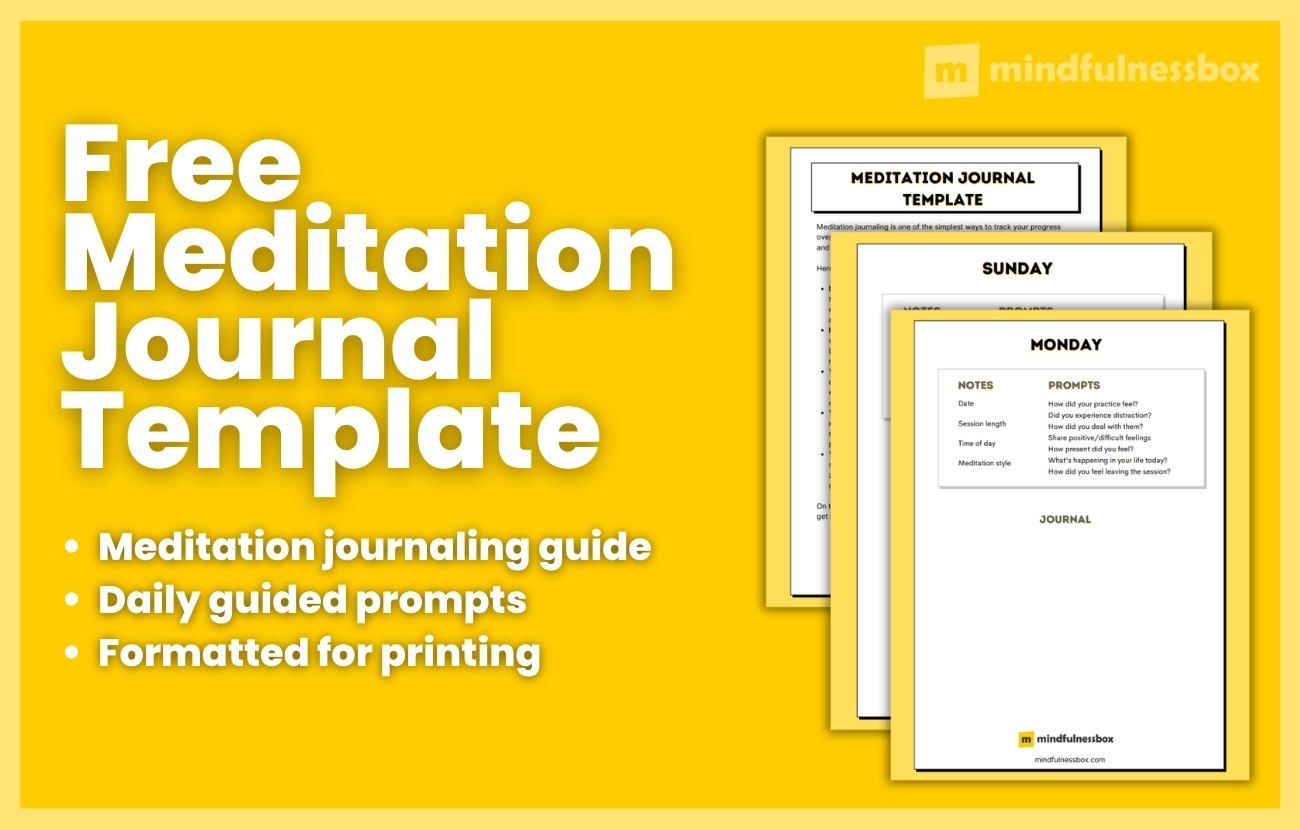
Sure, you can journal anywhere. But in case you’d like to make it a little easier, I’ve included a simple, free meditation journal template below. It’s a PDF.
Just download it and print. Or, feel free to copy and paste the questions into the note-keeping app of your choice to make your next meditation journaling session a little easier.
Here’s to reflecting, remembering your meditation successes, and building a meditation practice that can last for the long haul.
Step 2: Use meditation journal prompts
Wondering what exactly to write in your meditation journal?
Again, there’s no right or wrong approach to journaling meditation, but here are a few questions you might want to explore as you sit down with your journal:
- How did the practice go for you today?
- What distractions did you have?
- How did you deal with distractions?
- What positive feelings did you experience?
- What difficult feelings did you deal with?
- How present did you feel?
- Did anything going on in your life distract you?
The above meditation journal template includes prompts to help you with inspiration.
Step 3: When you get stuck, look at meditation journal examples

Let’s make it a little more concrete with meditation diary examples:
Day 1
Meditated for 15 minutes. My legs hurt. I was distracted for most of the beginning of the session. I started hearing voices from outside my house, and my mind focused on those. It was tough to bring it back. Towards the end of the session, I finally started to settle into a groove, but then the bell rang on my meditation timer. It felt like I almost got to a place of relaxation, but then, I didn’t get anywhere. I left the session feeling frustrated. Tomorrow I’m going to wear headphones and see if that helps.
Day 2
Meditated for 15 minutes. It was a little better than yesterday but not much. Wearing headphones helped to drown out the noises that distracted me yesterday. But the pressure of the headphones on my ears was another distraction. Again, my session started out with lots of distractions. My mind wandered endlessly from thought to thought. Lots of my thoughts were focused on the things I have to do later in the day.
I have a very busy day coming up, so that might have something to do with the challenges today. A few times, I was able to remember to pull myself into the present moment. By the end of the session, my thoughts were just starting to settle down. Tomorrow, I’ll try meditating a little longer.
Day 3
Meditated for 20 minutes today. This meditation was actually pretty good. Like the last two days, I started feeling very distracted. I used my headphones and turned on meditation music to drown out outside distractions. My thoughts strayed away from the present moment towards distractions quite a bit. But around the 15 minute mark, my mind started to settle down. The last few minutes of the session were truly calm and relaxing. I left the meditation session with a feeling of calmness. It was a great way to start the day. This is a good formula for me.
Day 4
Meditated for 20 minutes today. Almost right away, my leg started to hurt. I couldn’t get into a comfortable position. I was hoping to reach the feeling of calm and relaxation from yesterday, but I never did. Maybe by trying to get there, I made it hard for me to actually get there. And in any case, I was distracted the whole time by my leg, and by the other distracted thoughts that normally pop into my head. I left the session feeling disappointed, because I thought I had figured out a formula that worked for me.
Day 5
Meditated for 20 minutes today. Today’s experience was pretty good. I didn’t have any leg pain like yesterday, and I was successful at bringing my attention back to the present moment when it strayed. I did that at least a handful of times that I remember. The last minute or two of the session, my mind felt more clear and I felt more relaxed.
The purpose of a meditation journal
The goal of a meditation journal is to record your experience of meditation over time so you can follow the ups and downs of your practice, and notice trends.
Here are a few benefits a meditation journal can bring to your practice:
- It makes your progress tangible: Rather than relying on your memory to notice how far you’ve come during your practice, you can flip back to earlier sessions, comparing your experience then with your experience now.
- It reminds you of past successes: When you have a couple of challenging meditation sessions in a row, you can start to feel defeated. Looking through past journal entries where you described positive meditation experiences can be motivating.
- You can identify trends over time: For example, you might notice that over time, when you meditate in the morning, it’s usually a better experience than meditating in the afternoon. You can adjust your experience accordingly to create a better experience for yourself.
- You can share your experience with a trusted meditation teacher: A meditation journal can be easily shared with a meditation teacher, who may notice trends that you don’t, and offer approaches to make your practice easier.
- You can zoom out: It’s easy to get caught up in how today’s meditation session went, or how it’s going this week. Journaling allows you to zoom out and take a bird’s eye view of your practice, noticing how it goes over weeks, months, or even years.

How to keep a meditation journal

To write in a meditation journal, get started by finding a blank piece of paper or a journal, or opening a note on your smartphone.
There are a few basics you might want to record for each session:
- The date
- How long you meditated
- The style of meditation you’re practicing
Once you’ve got those basics, simply start reflecting on your experience and write it down. There’s no right or wrong way to manage meditation and journaling. Write down whatever comes to mind, including positive experiences, challenges, comfort, discomfort, boredom, itchiness, a feeling of flow and being present–anything.
Something to be aware of:
When you start journaling about your meditation experience, you may find that this becomes an element of distraction in your meditation itself. Pay attention to whether you’re “rehearsing” during the course of your meditation for what you’ll journal. If you find yourself thinking during your meditation, “Ooh, that would be good to write down later,” try to gently pull yourself back to the present moment.
Frequently Asked Questions
What is a meditation journal?
A meditation journal is a record of your meditation practice — what you noticed, how it felt, what got in the way, and what didn’t. It can be a sentence or a page. It can live in a dedicated notebook, a notes app, or the back of a receipt you found in your bag. The format is genuinely not the point. What a meditation journal actually does is give you something to look back on — so that when you’ve had three rough sessions in a row and you’re convinced you’ve somehow broken your practice, you have evidence that this has happened before and passed.
What is a meditation journal template, and do I need one?
A meditation journal template is a simple set of prompts — date, session length, what you noticed, how you felt — that gives your entries some structure. It’s useful if staring at a blank page makes you want to close the journal and go do literally anything else. It’s not useful if filling out a form makes the whole thing feel like admin.
The honest answer is that some people find templates make journaling faster and more consistent, and some people find them constrictive. Try the template in this article for a week. If it helps, keep using it. If it makes you like journaling less, ignore it entirely and just write whatever comes.
What should I write in a meditation journal?
The basics are worth capturing: date, how long you sat, what style you practiced. After that, write whatever feels true about the session. What your mind kept doing. Whether you felt settled or scattered. What was hard. What surprised you.
You don’t need to perform insight. “My brain would not stop making grocery lists” is a completely valid entry. So is “I fell asleep and I’m counting it anyway.” The goal is a record you’ll actually recognize when you read it back — not a highlight reel.
How long should a meditation journal entry be?
As long as it needs to be, which is usually shorter than you think. Two or three sentences is enough to capture what actually happened. A paragraph is plenty. The entries that go on for a page are sometimes the most useful ones and sometimes just the sessions where you had a lot of feelings and needed to put them somewhere — both are fine.
If you’re finding that short entries make journaling sustainable and long entries make you dread it, write short entries. Consistency over completeness, every time.
How is a meditation journal different from a regular journal?
Scope, mainly. A regular journal can go anywhere — your relationships, your anxieties, the thing someone said to you six years ago that you’re still annoyed about. A meditation journal stays close to the practice itself: what happened during the session, what you noticed, how it might connect to patterns you’re tracking over time.
That said, the line blurs. If something in your meditation kept pulling you back to a conversation you need to have, noting that isn’t off-topic — it’s exactly the kind of thing a meditation journal is for.
Can I use my phone as a meditation journal?
Yes. A notes app, a voice memo, a document — whatever you’ll actually use. There’s a reasonable argument that writing by hand helps you slow down and process, and that’s probably true for some people. There’s also a reasonable argument that the journal you actually open is better than the beautiful leather one sitting on your nightstand making you feel guilty. Pick the format that has the lowest barrier to entry.
What if I meditate and don’t feel like journaling after?
Then don’t. The meditation was still the meditation. Journaling after every single session is not a requirement — it’s a tool, and tools don’t have to be used every time to be useful. If you journal after the sessions where something interesting happened, or when you’re trying to troubleshoot something in your practice, that’s more than enough.
If you’ve gone weeks without journaling and you’re wondering whether to start again: yes, start again. There’s no re-onboarding process. Just open it and write today’s date.
Can a meditation journal help if my practice feels stuck?
This is actually where it’s most useful. When your practice feels like it’s going nowhere, the journal is the thing that shows you it’s going somewhere — slowly, non-linearly, like most things that are actually working. Reading back through a month of entries tends to reveal patterns you couldn’t see from inside any single session: times of day that consistently go better, what’s happening in your life when the sessions get hard, how many times you’ve been exactly here before and come out the other side.
The journal doesn’t fix a stuck practice. But it does give you a longer view than the one you have when you’re in the middle of it.
The content shared here is for informational purposes only and is not a substitute for professional medical or mental health advice.