Skip the prep with 61 printable mindfulness activities for classrooms & counseling

The Mindfulness Five Senses Exercise: How to Use 5-4-3-2-1 to Calm Down Fast
This post contains affiliate links. If you click and make a purchase, we may earn a small commission at no extra cost to you.
There is a moment, right before a spiral becomes a full spiral, where you are still partly watching yourself from the outside. You can see what’s happening. You know it’s happening. You just can’t seem to grab onto anything. That is the exact moment the mindfulness five senses exercise was built for.
The mindfulness five senses exercise — also called the 5-4-3-2-1 grounding technique, also called “that thing my therapist taught me that I kept forgetting to try” — is one of those tools that looks embarrassingly simple on paper and then actually works. Not because it’s magic. Because it gives your nervous system something more immediate to pay attention to than the story currently playing at full volume in your head.
Here’s how it works, and more importantly, when.
Table of Contents
What the Mindfulness Five Senses Exercise Actually Is
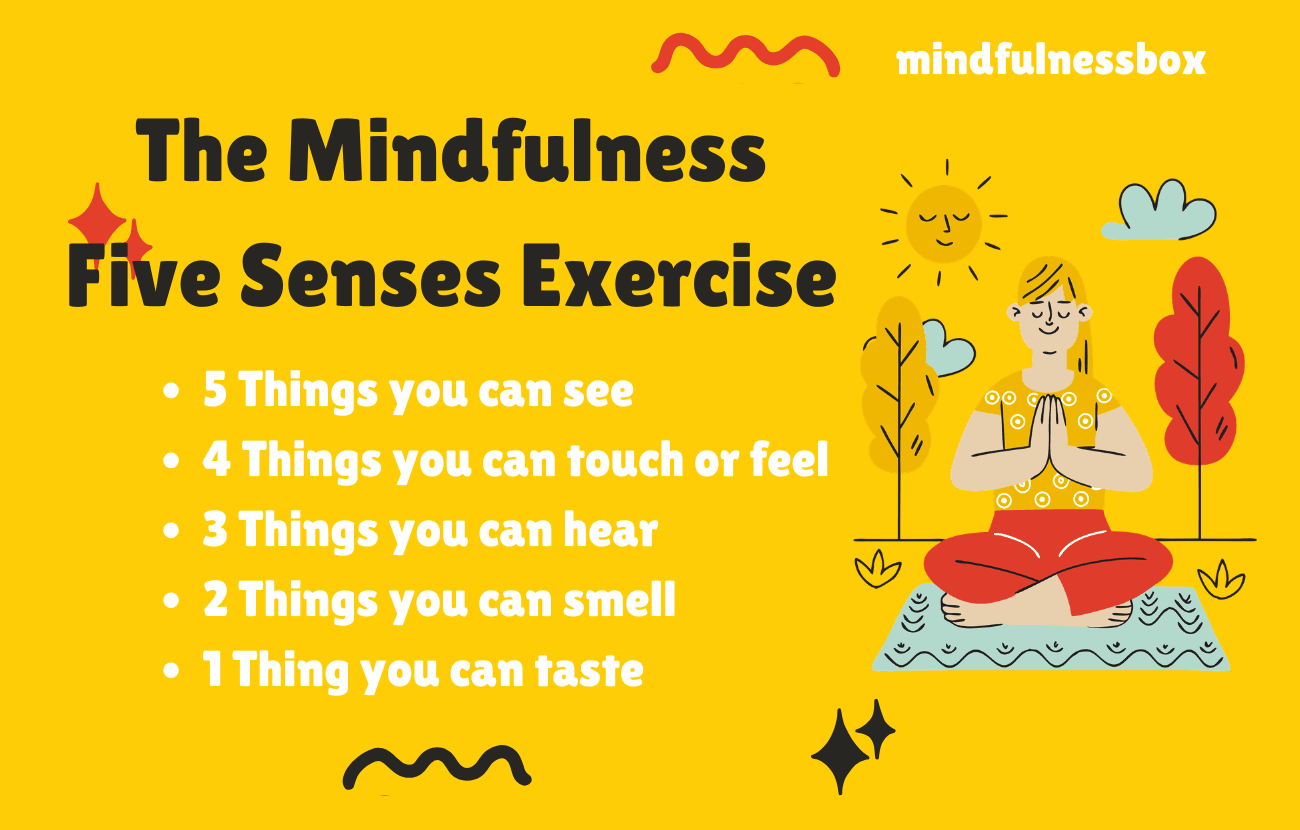
The premise is almost aggressively unglamorous: you use your senses to notice what is physically present around you, in a specific countdown order. Five things you can see. Four things you can touch or feel. Three things you can hear. Two things you can smell. One thing you can taste.
That’s it. No app required. No special cushion. No clearing of the mind, which is good, because clearing the mind is not actually a thing you can do.
What you’re doing, and this is the part worth understanding, is deliberately shifting the brain’s attention from the abstract to the concrete. When you’re anxious or overwhelmed, your nervous system is usually occupied with something that isn’t happening right now: the meeting tomorrow, the thing you said three years ago, the catastrophe that statistically will not occur. The five senses exercise doesn’t try to argue with any of that. It just hands your brain something else to do. Something present, specific, and undeniable. That lamp. This chair. The hum of the refrigerator.
You can’t catastrophize a lamp. It’s just a lamp.
How to Do the Mindfulness Five Senses Exercise
Go slowly. This is not a speed round. Each item gets a moment of actual attention, not a quick glance and a checkbox.
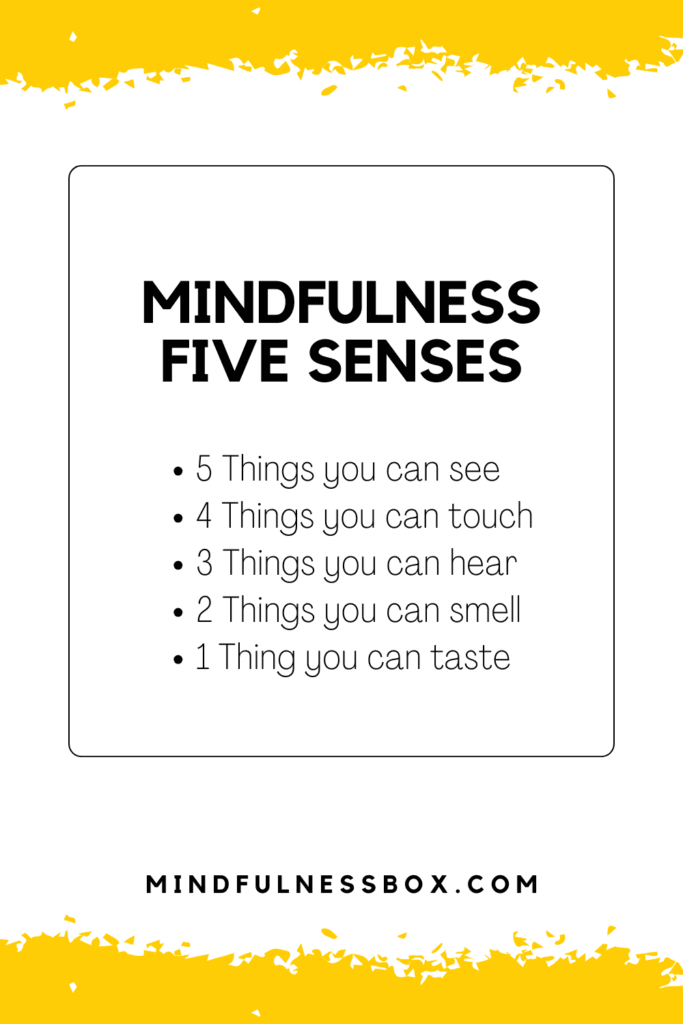
5 Things you can see
Look around. Really look. Not at your phone. Find five specific things and let your gaze rest on each one — the edge of the window frame, the grain of the table, the specific blue of that mug. If your mind wanders mid-item, that’s fine. Notice that it wandered and come back to the thing.
4 Things you can touch or feel
You don’t have to move around the room for this one. Feel the pressure of the chair against your back. The texture of your sleeve. The temperature of the air on your arms. The weight of your feet on the floor. Physical sensation is one of the fastest paths to the present moment. Your body is always here, even when your brain isn’t.
3 Things you can hear
Close your eyes for this one if that helps. Listen past the obvious sounds to the ones underneath. Traffic in the distance. The ambient hum of the building. Your own breathing. We spend most of our lives tuning sound out; this is the part where you tune back in.
2 Things you can smell
This is the step that makes people feel slightly silly, which I would like to normalize. You don’t have to sniff the air dramatically. Just notice what’s there — coffee, something cooking, fresh air, nothing in particular. Smell is the sense most directly wired to the limbic system, which is the part of the brain most involved in emotional regulation. This step is doing more work than it looks like.
1 Thing you can taste
The lingering taste of whatever you last ate or drank. The neutrality of plain saliva, which sounds unpleasant as a phrase but is genuinely a valid answer. The point is to drop your attention to your mouth, which is a strange and oddly effective thing to do.
By the end of the countdown, most people find they have slowed down. Not fixed. Not transformed. Just, slower. The volume has come down a notch. That notch is useful.
Why It Works (Without Getting Too Clinical About It)
The short answer: anxiety is almost always future-tense. The mindfulness five senses exercise is relentlessly present-tense. Those two things cannot fully occupy the same moment.
The slightly longer answer: when your nervous system is in threat-response mode, it is scanning for danger and not finding much else useful to do. Giving it a specific, benign task — find five things, now this, now this — redirects that scanning energy without forcing relaxation. You’re not telling your nervous system to calm down, which it will cheerfully ignore. You’re giving it a different job.
The honest caveat: if you are already at the absolute peak of a panic attack, this may feel impossible or even absurd. A lamp is not going to help you at a level 9. This technique works better as an early intervention. Something to reach for when you notice the spiral beginning, not after you’re already at the bottom of it. Use it earlier than you think you need to.
When to Use the Mindfulness Five Senses Exercise
Before a stressful meeting or call
Two minutes in the car or bathroom beforehand. You’ll go in more present and less pre-defended, which usually makes the meeting go better. If you work remotely, pairing this with other grounding exercises for Zoom meetings can help you arrive at the call actually settled rather than just technically present. This is also just a good use of two minutes.
Mid-anxiety spiral
The classic use case. When the thoughts are picking up speed, the countdown gives you something to do with your hands and eyes that isn’t refreshing your email or texting someone who can’t actually help.
After a hard conversation
The adrenaline doesn’t just turn off because the conversation ended. Give your body a few minutes to actually land before you start replaying every sentence you said. Five things you can see first. Replay later, maybe.
With kids who are upset
Children are surprisingly good at this. They haven’t learned yet to feel stupid about paying attention to their senses. You can do it together, which also has the useful effect of giving you something collaborative to do when they’re upset instead of just trying to problem-solve at each other. For more structured ideas, see this list of mindfulness activities for kids.
Before sleep when your brain won’t stop
The lying-in-bed version is slightly different since the visual field is limited (ceiling, ceiling fan, the darkness behind your eyelids), but the tactile and auditory steps are particularly effective at night. The weight of the blanket. The sound of the house settling. This is not a cure for insomnia but it is better than lying there arguing with your thoughts. If nighttime rumination is a recurring issue, the broader strategies in how to stop overthinking at night are worth reading alongside this one.
As an ordinary mindful moment
Here is the thing most articles about this technique skip entirely: you don’t have to be in distress to use it. Done slowly on a Tuesday afternoon, just because, it is a genuinely pleasant way to inhabit whatever room you’re in. Not everything needs to be therapeutic. Sometimes it’s just nice to actually notice the light.
A Few Variations Worth Knowing
The silent version
Do it entirely internally, no narrating out loud, no writing things down. Just eyes moving, attention landing, moving on. Works well in public spaces where you’d prefer not to be seen quietly describing your surroundings.
The kids version
Make it a game. “Can you find five things that are blue?” is a five senses exercise with a slightly more entertaining wrapper. Children do not need to know the technique has a name.
The shorter version
On days when five full rounds feels like too much, just do the first step. Five things you can see, slowly. That’s enough to interrupt a loop. Perfection is the enemy of actually doing the thing. For more approaches that take under sixty seconds, one-minute mindfulness exercises covers several that pair well with this one.
Tools for the Mindfulness Five Senses Exercise
A 5-4-3-2-1 reference card, small enough for a wallet or stuck to the inside of a cupboard, is one of those things that sounds unnecessary until the moment you need it and can’t remember what comes after “four things you can touch.” Here are some great options:


The technique will not fix your life. It will not resolve the meeting or repair the relationship or make the uncertainty go away. It will give your nervous system a small, useful thing to do when the story in your head has gotten louder than is helpful.
Most of the time, that is exactly enough.
Frequently Asked Questions
How many times should I repeat the mindfulness five senses exercise?
Once through the full 5-4-3-2-1 countdown is usually enough to shift your state noticeably. If you still feel unsettled, you can repeat it. But most people find one slow, attentive pass does the job. The goal is presence, not repetition.
Can I do the mindfulness five senses exercise with my eyes open or closed?
Either works. Eyes open is often more grounding because you’re actively engaging with your physical environment. Eyes closed can help with the hearing and smell steps if you find visual input distracting. Experiment and use whatever helps you land in the moment.
Is the 5-4-3-2-1 technique the same as mindfulness and grounding?
It’s one form of grounding, which is itself a core mindfulness skill. Grounding practices use sensory awareness to anchor attention in the present moment. And the five senses countdown is one of the most structured, accessible ways to do that. Think of it as a specific tool within a broader category.
What if I can’t smell or taste anything during the mindfulness five senses exercise?
That’s fine. Notice the absence. “I don’t smell anything distinct right now” is still a present-moment observation. The point of those steps is to redirect attention to your mouth and nose, not to produce a dramatic sensory experience. Neutral is a perfectly valid result.
Does the mindfulness five senses exercise work for children and teenagers?
Yes, and often very well. Younger children respond better when it’s framed as a game rather than an exercise. “Let’s find five things that are red” works just as well as the standard version. Teenagers tend to appreciate a brief, honest explanation of why it works rather than being told to just try it.
The content shared here is for informational purposes only and is not a substitute for professional medical or mental health advice.